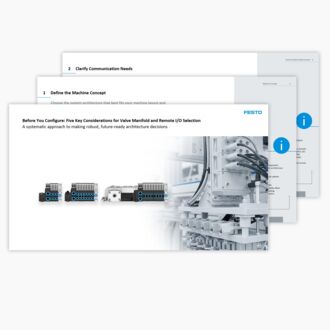
Consideration Guide
Five Considerations Before You Configure a Valve Manifold
Define the requirements that should guide your valve manifold and remote I/O architecture before you compare routes or configurations.
Build a clearer requirement profile before selection
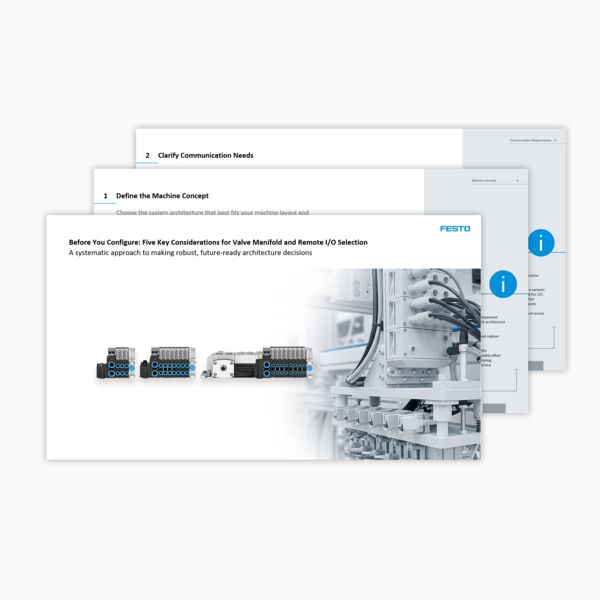
Use the guide to structure your decision around five connected considerations. You will be able to:
- Define the machine concept and communication needs
- Capture pneumatic performance and integrated-function requirements
- Assess engineering and commissioning implications
- Identify what is required, optional, not relevant, or still needs validation
What the guide helps you do
Clarify the architecture decision
Define the machine concept before product comparison. Capture where pneumatic control and remote I/O should sit, which layout and service constraints matter, and which machine variants or customer standards could influence the architecture direction.
See trade-offs earlier
Look beyond component price and compare how the decision can affect hardware variants, cabling and tubing, installation space, engineering work, commissioning, and servicing. Keep unresolved technical or availability questions visible instead of assuming them away.
Align the project team
Create one requirement profile that mechanical design, controls, purchasing, commissioning, and other stakeholders can use as a shared baseline. Separate confirmed needs from optional capabilities and points that still require validation.
A criteria-first approach to selection

Before you compare variants, make the requirements visible. A structured profile helps separate what the machine needs now from what is optional or still needs validation, so the next selection step starts from a clearer technical basis.
Ronald Johnson
Product Management Valve Manifolds
Festo
Get the valve manifold Consideration Guide